
Do Track Day and Club Racers need a HANS device?
Date Posted:23 March 2026
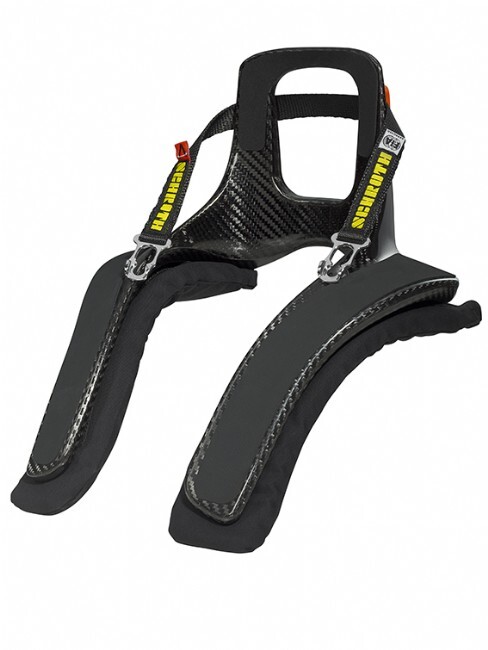
You have fitted a roll cage, a fixed back seat, and a harness. One piece of safety gear is still missing. A HANS device links your helmet, harness, and seat into one system that protects your neck. This guide covers what it is, whether it will work in your car, why prices differ so much, and how to fit it.
Will a HANS Device Work in Your Car?
Check this first, before anything else. A standard HANS device needs straps running over both shoulders, so it only works with a 5 point or 6 point harness fitted to a caged car with a racing seat.
If your car still has factory 3 point belts, a standard HANS device will not work. Do not force it to fit. This is common for driving instructors, track day students, and anyone racing a street registered car without a cage. One option exists for exactly this setup. The Simpson Hybrid S is FIA 8858 and SFI 38.1 approved for standard racing harnesses, and Simpson's own third party FMVSS 208 testing showed it also reduces neck tension when used with a factory 3 point belt, according to Simpson's published product testing. It works with the usual 4 point, 5 point, and 6 point harness too.
If you already have a caged car with a racing seat and harness, a standard HANS device is the right choice. The rest of this guide is for you.
Why Do Prices Vary So Much?
FHR device prices vary a lot. Material is the main driver of that gap, though tether style and brand also play a part. Every FIA 8858 certified device has to meet the same crash standard, whether it costs a few hundred dollars or a few thousand.
Composite devices weigh a little more and cost less. Carbon fibre devices are lighter and stiffer, and you pay extra for that weight saving. Many racers doing occasional track days choose a composite device to keep costs down, and step up to carbon fibre as they race more often.
What about buying secondhand?
Always check with the manufacturer or an FIA approved inspector before you buy. A device with a valid, in date FIA label and no visible damage can be a reasonable option, and tethers are a wear item that can often be replaced on their own. What you cannot verify from a listing photo is impact history, so ask the seller directly and get manufacturer confirmation where you can. If you cannot confirm both the certification date and the crash history, buy new.
How Does a HANS Device Work?
In a crash, your harness locks your torso in the seat, but your head keeps moving unless a HANS device is fitted. The tethers catch your helmet and send that force into the collar, then into your shoulders and chest instead of your neck.
Early crash testing by HANS device inventor Dr Robert Hubbard found that the threshold for a basilar skull fracture sits at around 740 lbs of neck tension, and that a HANS device cuts that load to around 210 lbs in the same crash. This research is why Formula 1 made the device mandatory in 2003 and NASCAR followed in 2005, and why the FIA's International Sporting Code now requires an FHR device in most categories under its Appendix L.
The device still lets you move your head to check mirrors and apexes. Sliding tethers give you extra range before they come under load, so your view is not blocked during normal driving.
Choosing the Right Size, Angle, and Anchors
Once you know a HANS device suits your car, three choices remain.
Angle
Club racers in upright seats commonly use a 20 degree device, while more reclined single seater or prototype positions typically need a 30 degree device. Per FIA Safety Bulletin 14, the collar angle must be set up between 60 and 90 degrees from horizontal once you are belted in, so check this with your harness fully tight before you buy.
Size
Racer reports and retailer fitment guides commonly cite a large, 20 degree device as the most frequent fit for adult men in a standard road based seat, though this varies by build. Measure your shoulder width instead of guessing. A device that is too narrow will dig in. One that is too wide will leave gaps.
Helmet anchors
Your helmet needs factory fitted or correctly drilled anchors to take the tethers. Follow the kit instructions closely, and do not mix hardware between brands. Older anchor posts can wear out, so check the spring still holds the tether firmly before every session. Replace any post that feels loose.
A Short History
Biomechanical engineer Dr Robert Hubbard built the first HANS device in the 1980s, after a friend died from a basilar skull fracture in a racing crash. The device was slow to catch on until the deaths of Ayrton Senna and Roland Ratzenberger pushed Formula 1 to act, and Dale Earnhardt's fatal 2001 crash at Daytona pushed NASCAR to follow. Early devices drew complaints about comfort and blocked vision. Manufacturers point to sliding tether systems as their answer to both complaints, though how much that matches your own experience will depend on the specific device and your seating position.
Common questions about HANS Device
Do I need a HANS device for a casual track day?
If you have a harness and fixed back seat, yes. If you still have factory belts, look at a 3 point rated device such as the Hybrid S instead of forcing a standard HANS to fit.
Can I use one HANS device across different cars and helmets?
Yes, as long as every helmet has matching anchors and every car lets the harness sit correctly over the collar.
Does a HANS device work with Simpson Hybrid systems?
No. HANS and Hybrid are separate FIA approved systems. They are not meant to be worn together. Pick the one that matches your seat position and belt setup.